
The Delhi high court on Friday sought response from the Central Bureau of Investigation (CBI) on the bail plea by former managing director and chief executive officer of the National Stock Exchange (NSE) Chitra Ramkrishna in connection with the co-location case. Justice Sudhir Kumar Jain issued notice on the bail application and listed the case for further hearing on May 31. The trial court had dismissed the bail plea of the former NSE boss on May 12 and said that no ground for bail was made out at this stage.

The Adani group will have understood the fragility of investor trust in the group. The group needs to improve transparency including in areas like share-ownership (which they have long and mistakenly believed can be side-stepped) and related-party transactions, among others, Amit Tandon and Hetal Dalal point out.

Head coach Thomas Dennerby was a witness to the 'incident' and it was he, who immediately informed the AIFF.

Expressing commitment to augment the country's infrastructure, Finance Minister Nirmala Sitharaman on Monday proposed to significantly enhance capital expenditure to Rs 5.54 lakh crore in the next fiscal, besides creating institutional structures and giving a big thrust to monetizing assets to achieve the goals of the National Infrastructure Pipeline (NIP). Sitharaman said NIP, that was launched in December 2019 with 6,835 projects, has now been expanded to 7,400 projects and around 217 projects worth Rs 1.10 lakh crore under some key infrastructure ministries have been completed. "For 2021-22, I propose a sharp increase in capital expenditure and thus have provided Rs 5.54 lakh crores which is 34.5% more than the BE of 2020-21," the finance minister said.

The Securities and Exchange Board of India (Sebi) has proposed measures mandating daily upstreaming of all investor funds from stockbrokers to clearing corporations (CCs). The step, aimed at reducing risk on client funds, will further deplete brokers' revenues as they will lose interest income with transfers being done daily. At present, stockbrokers convert the surplus funds into bank guarantees (BG) or fixed deposit (FD) receipts which earns them extra income.

India's dream to be in the forefront of international politics has come true. India has placed itself firmly as a major player in the shaping of a new world order, observes Ambassador T P Sreenivasan.

It could be a matter of concern that foreign shareholders of the NSE are registered in tax havens such as Mauritius and Cyprus.

All banks are eligible for privatisation. A committee of secretaries will decide which banks will be privatised, says Financial Services Secretary Debasish Panda.

The Centre on Monday earmarked a separate Rs 2,217 crore for 42 urban centres to tackle air pollution and announced the much-awaited voluntary vehicle scrapping policy to phase out old and polluting vehicles, even as it shrunk the budgetary allocation for the environment ministry from the last fiscal by nearly eight percent. Union Finance Minister Nirmala Sitharaman, in her budget speech for 2021-22, announced a total of Rs 2869.93 crore for the ministry, Rs 230 crore less than the last fiscal. Officials said the outlay has been lesser this time as the economy is recovering from the COVID-19 pandemic.

India's macroeconomic situation is certainly better than what it was a year ago, eminent economist Pinaki Chakraborty said on Monday, while expressing hope that the country will be back on the path of economic growth if there is no major third wave of the COVID-19 pandemic. In an interview with PTI, Chakraborty, who is the director of the National Institute of Public Finance and Policy (NIPFP), said that inflation may remain at an elevated level as there was a significant fiscal and monetary expansion in the last 18 months. "The current macroeconomic situation is certainly much better than what it was one year back. We are seeing recovery in most sectors," he said. Chakraborty noted that COVID-19 vaccination has been going on at a very fast rate in India.
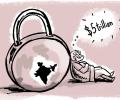
In order to achieve $5 trillion GDP by FY'25, India needs to spend about $1.4 trillion over this period on infrastructure, according to the Economic Survey. During financial years 2008-17, India pumped in about $1.1 trillion on infrastructure. However, the challenge is to step up infrastructure investment substantially, the Economic Survey 2021-22 said.

In his final address, the president said that the soul of India resided in "pluralism and tolerance.

India needs a place where all regulators could gather and function as in a war room.

'India's defining characteristic has been its ability to manage and sustain democratic governance through an accommodation of ethnic, linguistic, and religious diversity.'

Join us for a chat with Vidhu Shekhar, country head - India, CFA Institute on Wednesday, June 1 between 3 pm and 4 pm IST.

'This move rendered the chiefs of important investigative agencies to the status of daily wage earners. It undermined the autonomy and independence of the agencies.'

7 key areas that the Budget must address to re-energise the infrastructure sector, suggests Vinayak Chatterjee.

India must be prepared to deal with climate disasters, geopolitical confrontations, and social strife linked to global events, asserts Jayant Sinha, chairman of Parliament's Standing Committee on Finance.

Finance firms in these SEZs likely to get tax breaks.

Real estate developer Supertech on Friday was declared bankrupt by the National Company Law Tribunal (NCLT), a move that could have a bearing on 25,000 home buyers of the firm's ongoing projects in the Delhi and NCR region. Acting on a petition filed by the Union Bank of India for non-payment of around Rs 432 crore worth dues, the bankruptcy court ordered the initiation of insolvency proceedings against real estate firm Supertech Ltd, one of the companies of Supertech group. The NCLT said "there has been a default in payment of the financial debt" and appointed Hitesh Goyal as the Interim Resolution Professional (IRP) superseding the board of Supertech Ltd.

China's covid crisis could provoke a raw material crunch for India's EV industry later this year.
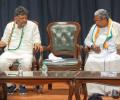
There are lessons for the Congress to learn from the Karnataka elections of how burying the hatchet among top leaders and not washing dirty linen in public can help, says Ramesh Menon.

A paper authored by Rajan said, state-linked banks can be a first step in altering the ownership structure of some PSBs, where the government brings down its stakes to below 50 per cent, creating distance from operations of banks, and improving governance along the way.

Stock exchanges and other market infrastructure institutions as well as their top officials are liable to face penalties for lapses in handling and recitfying technical glitches, with Sebi putting in a place a stricter compliance system driven by "financial disincentives". The markets watchdog has come out with a detailed Standard Operating Procedure (SOP) for Market Infrastructure Institutions (MIIs) less than five months after a technical glitch halted trading at the country's largest bourse NSE for nearly four hours. There will be a "financial disincentives" structure for MIIs -- stock exchanges, clearing corporation and depositories -- for any business disruption beyond pre-defined time, according to a circular issued on Monday.

Policies to break down the business group format are far more likely to be effective, argues Simon Commander.

'We are not able to manufacture even low-end products as cheaply as China.' 'We are not buying Chinese goods today out of any love for China.'

The RBI's financial stability report has on Wednesday highlighted the disconnect between the real economy and equity market yet again. The central bank observed that Indian equities were trading at rich valuations, with several metrics such as price to earnings multiples, price to book ratio, market cap to GDP and the cyclically adjusted P/E ratio, or Shiller P/E, at above historical averages. For instance, as on December 13, the one-year forward P/E ratio for India was 35.1 per cent, above its 10-year average, and one of the highest in the world.

Indeed, there were frauds, and the politician-banker-industrialist nexus played a role in the rise of NPAs, but governance issues in Indian banking are far more nuanced and complex, reveals Tamal Bandyopadhyay.

Tech is also being used to stem resignations, which have recorded a rise amid COVID-19.

Of the total, the financial creditors - banks, bond holders and other financial institutions - have claimed Rs 86,892 crore.
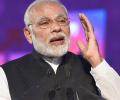
Days after the fraud allegedly masterminded by diamantaire Nirav Modi came to light, the prime minister asked the management of financial institutions as well as the supervisory bodies to do their job diligently to check such frauds.

Because they have become too big and pervasive and the time to regulate is long gone, points out Debashis Basu.

The branch managers have come out of their glass cabins and the sellers' market has transformed into a buyers' market, but there is no end to the harassment of customers, asserts Tamal Bandyopadhyay.

There is money to buy the central public sector enterprises, but buyers will need a firm assurance that the disvestment programme will keep environment issues front and centre of their corporate plans.

In renaming TRS and repositioning it as a 'national' party, KCR is also eyeing a pole position in opposition politics ahead of the 2024 Lok Sabha elections.

After getting rapped for accepting Vedanta group's bid that would give just 5 per cent of their outstanding loans, lenders to Videocon Industries on Monday approached the insolvency appellate tribunal NCLAT seeking fresh bids for the debt-laden consumer durable firm. Billionaire Anil Agarwal's Twin-Star Technologies had offered Rs 2,962 crore to takeover Videocon Industries, which was 4.15 per cent of the admitted claims of Rs 64,838.63 crore of lenders. SBI, the leading lender of Videocon Industries, has approached the National Company Law Appellate Tribunal (NCLAT) requesting for a rebidding of the 13 companies of the debt-ridden group, on account of strong observations against Rs 2,962 crore takeover bid by Anil Agarwal's Twin Star Technologies.

A PhD from Chicago-Booth and a top-ranking IIT-IIM alumnus, Krishnamurthy Subramanian is one of the world's leading experts in banking, corporate governance and economic policy

This is the full text of Prime Minister Manmohan Singh's address to media persons ahead of his interaction with them in New Delhi on Friday

In December, Aisha Shah was named as Partnerships Manager at the White House Office of Digital Strategy.

The World Bank has announced that it will stop all its programmes in Russia and Belarus with "immediate effect" in response to Moscow's military operations in Ukraine and "hostilities" against the people of the war-torn country. On February 24, Russian forces launched military operations in Ukraine, three days after Moscow recognised Ukraine's breakaway regions - Donetsk and Luhansk - as independent entities. The decision comes as a large number of countries, organisations and businesses are severing ties and have imposed sanctions on Russia over the country's invasion of Ukraine, and with Belarus for its support and cooperation with Moscow.
